
Jump to section
Key takeaways
- Discharge instructions have two jobs: tell the owner what to do at home, and record what you told them.
- Most of them fail on the first job while doing the second perfectly well.
- The fixes are mostly about wording. Specific actions, plain language, and a short list of things that warrant a call back.
- A template gets you consistency. The worked example below shows what one looks like filled in.
To write veterinary discharge instructions, cover six things: what was done, medications with exact timing, activity restriction, feeding, what normal recovery looks like, and when to call. Write each one as a specific action rather than a general principle, and keep the whole thing to a single page a worried owner can follow in their kitchen at nine at night.
That last part is where most discharge sheets come unstuck. They are usually accurate, complete and clinically correct. They are also written for a reader who is calmer and better informed than the person actually holding them.
What are veterinary discharge instructions?
They are the written aftercare the owner leaves with. Depending on the practice they might be called a discharge note, go-home instructions or an aftercare sheet, and the terms get used interchangeably.
Whatever you call it, the document is doing two separate jobs at the same time.
The first is practical. Somebody who is not medically trained has to give the right drug at the right time, spot a complication, and keep a lively dog quiet for ten days. The second is a record. If a patient comes back worse, the discharge sheet is what shows the owner was told about the risk, the restriction and the follow-up.
A sheet can do the second job perfectly and still fail the first. That is the common failure, and it is almost always a wording problem rather than a content problem.
What should veterinary discharge instructions include?
Six sections cover almost every case. Minor procedures might collapse two of them into a line. Complex ones need more detail inside each heading, not more headings.
What was done
One or two plain sentences. The owner will read this part out to their partner, so write it to be read aloud.
Medications
Drug, dose, how often, with or without food, how many days, and what to do about a missed dose.
Activity
What the animal can and cannot do, for how long, and practically how to achieve it in a normal house.
Food and water
When to offer, how much, what kind, and what a normal appetite looks like over the first day or two.
What is normal
The part most sheets skip. Owners call about grogginess and mild bruising because nobody told them to expect it.
When to call
A short list of specific signs, with the number to ring and who answers it out of hours.
Section five earns its place by reducing phone calls. Every practice has fielded an anxious call about a pet that is sleepy after a general anaesthetic. That call happens because nobody wrote down that it was expected.
Why do clients miss what the instructions say?
Rarely because they do not care. Usually because of where and how they received the sheet.
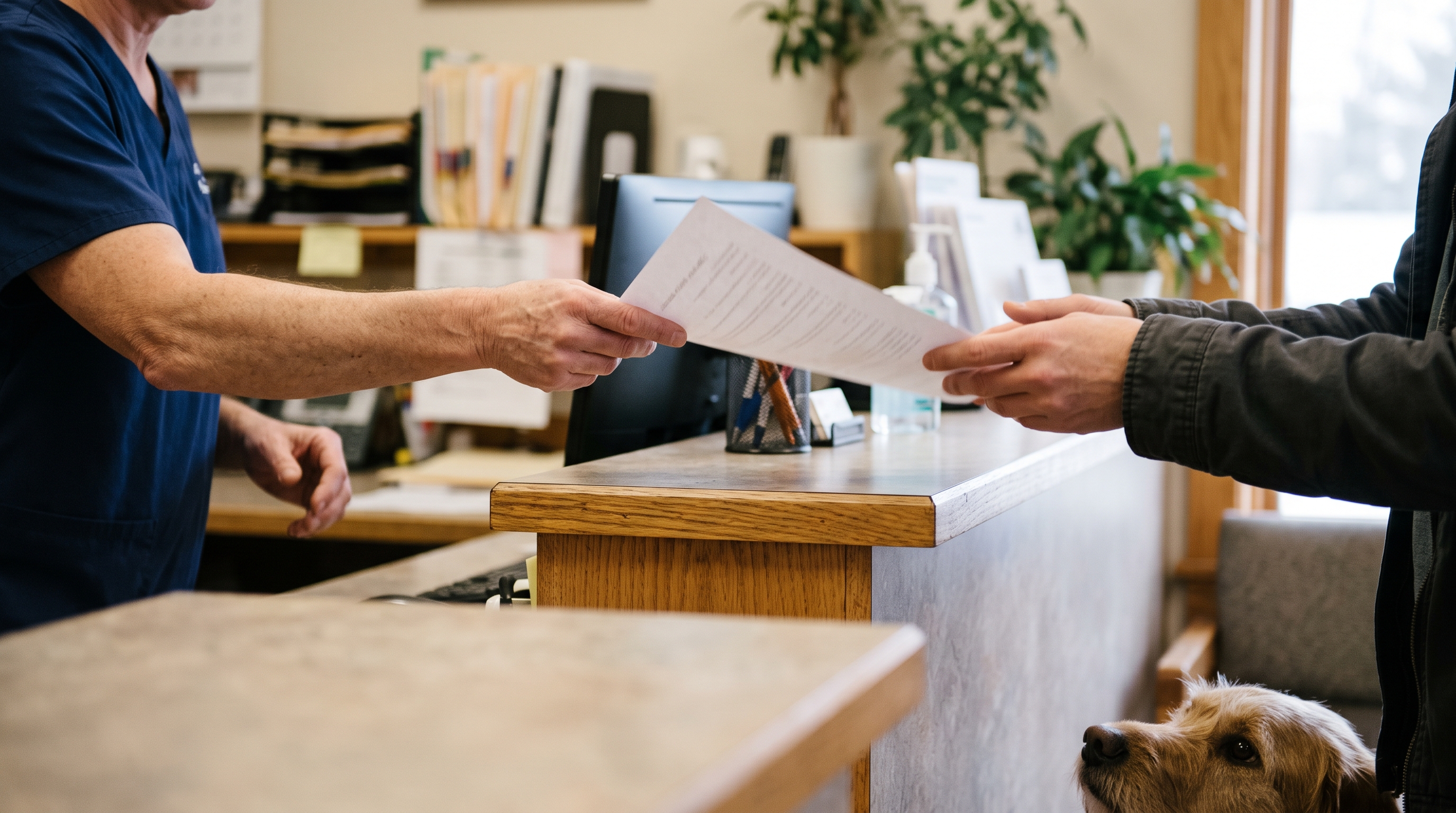
It is handed over at the counter, at the end of a stressful day, often by someone holding a lead in one hand and a card machine in the other. The owner is relieved, distracted and not absorbing much. The sheet goes in a bag and comes out again at home when something looks wrong.
Three things make that moment harder than it needs to be.
- Clinical vocabulary. Dehiscence, NPO, BID and q12h all mean something precise to you and nothing to the reader.
- Principles instead of actions. "Restrict activity" is a principle. "Lead walks only, five minutes, three times a day" is an action.
- Length. A three page sheet gets skimmed. The one thing that mattered was on page two.
How do you write instructions a client will follow?
Four changes do most of the work, and none of them require changing what you actually say.
Write the action, not the principle
Every instruction should pass a simple test. Could somebody carry it out tonight without asking a follow-up question? If not, it needs a number, a frequency or an example.
Easy to misread
Restrict activity for 10 to 14 days. No strenuous exercise.
Leaves the owner deciding what counts as strenuous. Most will guess generously.
Clear
Lead walks only for the next 14 days. Five to ten minutes, three times a day, for toileting. No stairs, no jumping on furniture, no off-lead running, no play with other dogs.
Nothing left to interpret, and it names the situations that actually come up at home.
Put timing in the owner's words
"Every 12 hours" is accurate and still gets missed. "One tablet in the morning and one in the evening, roughly 12 hours apart, with food" is harder to get wrong. Where a drug genuinely needs precise spacing, say so and say why.
Say what normal looks like
Give the owner the expected version before you give them the warning signs. Quiet and sleepy tonight. Eating less than usual tomorrow. Some bruising around the site by day two. Then the list of what is not normal reads as a genuine exception rather than a list of everything that could go wrong.
Keep the call list short and specific
A list of fifteen warning signs gets read as background noise. Four or five specific ones get remembered. Pick the signs that would genuinely change what you do, name them plainly, and put the phone number next to them rather than in the footer.
Related
Discharge notes in your own wording
Record the visit and the discharge note comes back in the template your practice already uses, ready to review and hand over.
See how templates workA worked example
A routine dental with two extractions, written the way the four rules above suggest. Patient details are invented.
Going home: Biscuit
Dental cleaning with two extractions · 22 October 2026
What we did today
Biscuit had a full dental clean under general anaesthetic. Two teeth on the lower left were loose and causing discomfort, so we removed them and closed the gums with stitches that dissolve on their own. Nothing needs to come out.
Medication
- Pain relief liquid: 1.2 ml by mouth, once a day with breakfast, for 4 days. Start tomorrow morning.
- Give it with food. On an empty stomach it can cause an upset tummy.
- If you miss a dose, give it when you remember, then carry on as normal the next day. Do not double up.
Food
- Tonight: a small meal, about half what she normally eats, once she is steady on her feet.
- Soft food only for 10 days. Soak her usual biscuits in warm water until they break apart easily, or use wet food.
- No bones, chews, hard treats or toys she bites down on, for 10 days.
- Water as normal from now on.
Activity
- Quiet at home tonight. She will be unsteady and should not use stairs on her own.
- Normal walks from tomorrow. No restriction on exercise.
- Keep her away from tug games and anything she would normally carry in her mouth, for 10 days.
What is normal
- Sleepy, wobbly and quiet this evening. She may not want her dinner.
- A little blood-tinged drool tonight.
- Eating more slowly than usual for a few days.
- Back to herself by tomorrow afternoon.
Call us if
She will not eat soft food by tomorrow evening, there is fresh bleeding from her mouth, her face looks swollen, or she is pawing at her mouth repeatedly. Daytime: 01234 567890. Out of hours the same number connects you to the emergency service.
Next steps
No appointment needed unless something above applies. We will ring you on Friday to check how she is doing.
Note what is not in there. No abbreviations, no drug class names, no "monitor for signs of infection". The clinical detail that belongs in the medical record stays in the SOAP note, where another veterinarian will read it. The discharge sheet is written for the person taking the animal home.
Common questions
What should veterinary discharge instructions include?
Six sections cover nearly every case: what was done, medications with exact timing and whether to give with food, activity restrictions, feeding guidance, what normal recovery looks like, and a short specific list of signs that warrant a phone call. Keep it to a single page and write each instruction as an action the owner can carry out without asking a follow-up question.
What is the difference between a discharge note and a SOAP note?
They have different readers. A SOAP note is the clinical record, written for other veterinary professionals, and it stays in the patient file. Discharge instructions are written for the owner and go home with them. The same visit produces both, and the clinical detail that belongs in one is usually wrong for the other.
How long should discharge instructions be?
One page for routine cases. Length is the enemy of compliance, because a long sheet gets skimmed and the one line that mattered gets missed. Complex cases need more detail inside each section rather than extra sections, and anything that is reference material rather than an instruction can go on a separate handout.
Should discharge instructions be in the medical record?
Yes. A copy of what the owner was given should sit in the patient file. If a patient is presented again with a complication, that copy is what demonstrates the owner was told about the restriction, the medication schedule and the signs to watch for. Practices that only print the sheet and hand it over lose that evidence.