
Contents
The short version
- Owners say they use AI for pet health far more often than veterinarians think they do, and most of them are not mentioning it in the room.
- A client holding up a phone is usually anxious rather than adversarial. When AI advice conflicts with their veterinarian, 64% follow the veterinarian.
- The answers sound confident because fluency and accuracy are different things. In one published test, rewording the same case produced a different diagnosis.
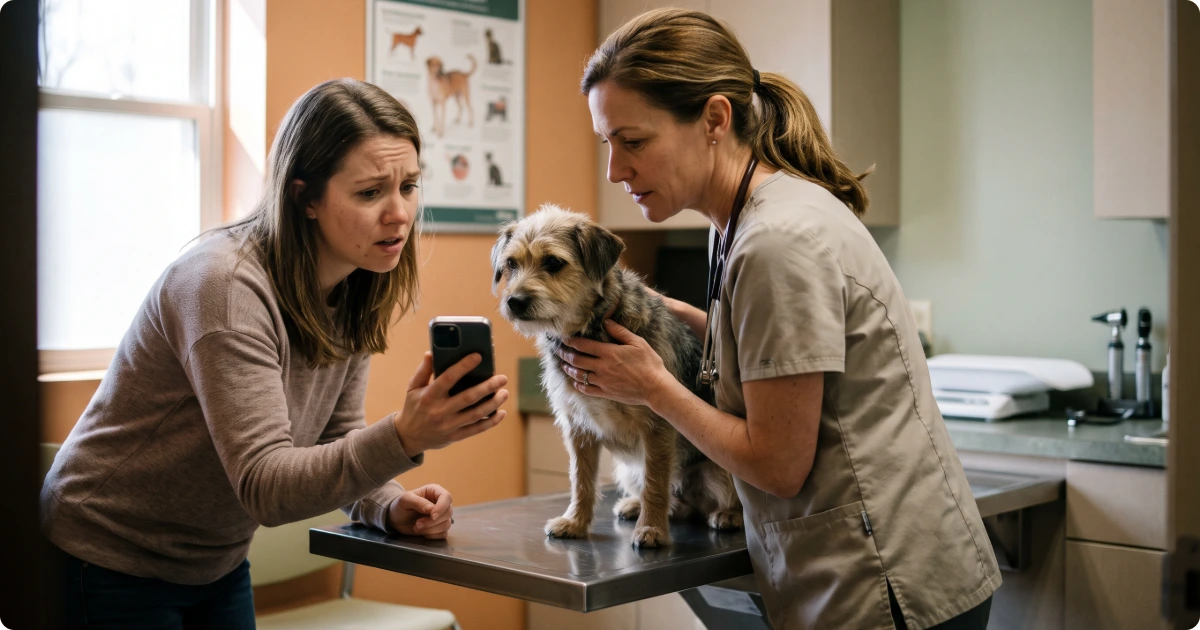
A client sets a phone on the exam table and turns it toward you. Before you have finished the physical, you are being asked to respond to a differential list that something else produced, written in clean paragraphs, with a confidence your own notes rarely have.
This is not the old Dr. Google conversation. A search result was a wall of links, obviously assembled by a stranger, obviously generic. A ChatGPT diagnosis arrives specific to the animal, organized, reassuringly calm in tone, and already structured as an answer. It is a harder thing to stand in front of, and the instinct to wave it away is the one move almost guaranteed to cost you the rest of the appointment.
Here is what the available evidence says about how often this is happening, what the client is usually after, and how to handle it without either dismissing them or ceding the room.
How many clients are doing this
More than you think, and that gap is the most useful thing in the data.
A survey of 2,000 US pet owners found that 43% have used AI tools such as ChatGPT to get information about their pet's health or nutrition, and that those who do consult them roughly seven times a week. The most common subjects were nutrition at 55% and symptoms or illness at 54%. Nearly six in ten, 59%, said an AI recommendation had changed how they care for their pet.
Veterinarians, asked the same kind of question from the other side of the table, put the number much lower. In the British Veterinary Association's Voice of the Veterinary Profession survey, vets in clinical practice estimated that around one in seven clients, 15%, are using AI technology in the care of their animals. Yet two-thirds of those same veterinarians reported having clients who used AI to try to diagnose an animal's health problem.
About those two numbers
They are not directly comparable and we are not presenting them as a contradiction. One surveyed US owners online and was commissioned by a pet food company. The other surveyed UK veterinarians and was run by a professional association. Different countries, different populations, different methods, and the owner figure counts anyone who has ever used AI while the vet figure is an estimate of a current client base.
What survives the comparison is the direction. Owners report doing this at a rate well above what the profession registers, and two-thirds of vets have already had the conversation at least once. Nobody has yet measured, in a single population, how many clients bring an AI answer into the room and say nothing about it.
The practical read is simple. If you are waiting for clients to announce that they consulted a chatbot, you are undercounting. Most of them will not raise it unless you do.
What the client usually wants
The phone on the table reads as a challenge. The survey data suggests it usually is not one.
Asked who they trust most for health and nutrition advice, 71% of owners named veterinarians and 14% named AI tools. Asked what happens when the two disagree, the gap widens further.
When AI advice conflicts with their veterinarian, who owners follow
Follow the veterinarian
Side with the AI
Neither stated
Talker Research survey of 2,000 US pet owners, April 2026, commissioned by Darwin's pet food. The remaining share is what is left once the two reported figures are accounted for.
Only 11% of owners said the accuracy of AI-generated responses was a top factor in deciding what to trust. Professional credentials came first, at 57%.
What the same survey also found is that this is not making owners feel better. 30% said using AI had made them more worried about their pet's health, and health was the single biggest trigger for second-guessing a decision, at 47%. Ninety percent said AI and online resources made them feel more informed. Both things are true at once, which is roughly what it feels like to read a confident paragraph about your own dog at eleven at night.
The client who looked it up is usually not trying to replace you. They are trying to find out whether to be frightened, and they arrived early because they could not wait for your opinion.
Why the answers sound so convincing
Worth knowing what is actually behind the paragraph, because it shapes what you say next.
In 2023 a group at the University of Veterinary Medicine Hannover and the Royal Veterinary College ran a small test. They took 20 dog cases from a referral hospital, five each of idiopathic epilepsy, structural epilepsy, paroxysmal dyskinesia and syncope, and fed each one to ChatGPT twice: first the history alone, then the history plus examination findings. Then they lightly reworded every record and ran the whole thing again from a different account.
The results were not uniformly bad. They were uneven in a way that matters:
- Syncope was its strongest category. From the history alone it identified a cardiovascular cause in four of five cases on the first pass and all five on the second.
- Paroxysmal dyskinesia it essentially missed. Zero of five on the first run, one of five after rewording, and adding examination findings pushed the answers toward epilepsy rather than away from it.
- Rewording changed the answer. Idiopathic epilepsy went from two of five correct to zero of five on nothing more than a rephrased version of the same case.
That last point is the one to keep. The authors note the model is sensitive to small changes in how a question is phrased, and their conclusion was blunt: it is not advisable at present to rely on it for diagnostic applications, and it is neither a thinking machine nor a model with medical-specific training.
This is an opinion article built on 20 cases from one hospital, with no statistical analysis and no comparison against clinicians. The authors say so themselves. It does not establish an accuracy rate. What it does illustrate is the mechanism: a system producing fluent, confident, internally consistent prose whose correctness varies by condition and can flip on a rewrite. Your client has no way to tell the four-of-five answer from the zero-of-five answer. Both arrive in the same calm voice.
What to say in the room
None of the following is clinical guidance. It is about the conversation.
Ask before they have to tell you
A plain question early in the appointment does most of the work: have you looked anything up about this? It costs five seconds, it is not loaded, and it moves the AI answer from something sprung on you at minute nine to something you are handling on your own terms. It also tells you what the owner is already frightened of.
Name what it got right
Most AI answers contain real information. If the differential list is reasonable, say so. Agreeing with the correct parts buys you enormous credibility for the part where you disagree, and it signals that you are evaluating the content rather than defending territory.
Separate the pattern from the patient
This is the central distinction and it is worth having a sentence ready. A language model is very good at describing what a cluster of symptoms usually means across everything that has been written about them. It has not examined this animal. It does not know what you felt on palpation, what the gums looked like, or that the dog flinched when you reached the left side. You are not telling the client their source is stupid. You are telling them it was working with a fraction of the information.
Give them the thing the model could not have
Then supply it. The specific finding from the specific exam is the strongest card you hold, and it is the one piece of evidence no chatbot can generate. "It suggested a thyroid issue, which is a reasonable thing to consider with these signs. What I found when I examined her points somewhere else, and here is what I felt."
Say what would change your mind
If the AI suggestion is worth ruling out, name the test that would rule it out and what you would do with either result. Owners who arrive with research tend to be receptive to diagnostics, because something already convinced them the problem is worth investigating. Giving them a concrete next step converts anxiety into a decision.
What not to do
- Do not dismiss the tool itself. "You can't trust that thing" is heard as "you were foolish," and 43% of your clients are using it. You will be having this conversation again next week.
- Do not read the whole chat in silence. Taking the phone and scrolling without speaking reads as judgment and burns the clock. Ask what worried them most about what it said.
- Do not try to out-cite it. A model can produce more plausible text on any subject than you can produce in an exam room. Your advantage is not volume of information. It is that you have the animal in front of you.
- Do not let it go unrecorded. If a client raised an AI-generated concern and you addressed it, that belongs in the record like any other client communication, especially if you declined a test they asked about.
Related
Keep the conversation in the record
Record the visit and the note comes back in your own template, what you discussed included, ready to review and file into your practice software.
See how VetSkribe AI worksThe part that is bigger than one appointment
Individual conversations are only half of it. The BVA survey found that almost half of veterinarians said their workplace had no AI use policy, and around one in three did not know whether one existed. That is a gap worth closing before it becomes a complaint.
In October 2026 the BVA published a toolkit to address exactly this, including guidance on discussing AI-generated information with clients, a workplace policy template and a waiting-room charter. It is UK-focused and available to BVA members. As of this writing we are not aware of an equivalent US resource, which is a gap somebody will fill.
A practice-level position does not need to be long. It needs to answer a few questions consistently, so that two veterinarians in the same building do not handle the same situation two different ways:
- Does the team ask clients, routinely, whether they have researched the problem?
- How is an AI-generated concern documented when it affects what was discussed or declined?
- What does the practice say publicly about AI as a source of pet health information?
- Where does the practice itself use AI, and what do clients get told about that?
That last one matters more than it looks. It is difficult to hold a consistent line on client AI use while being vague about your own.
Where we stand on this
VetSkribe sells AI documentation software, so read the above with that in mind.
It is also why the distinction matters to us. A consumer chatbot offering a diagnosis for an animal it has never examined, to an owner with no clinical training, is a different thing from a tool that writes down what a licensed veterinarian found during an exam they performed and will not file until they approve it. The first substitutes for the clinician. The second documents them. We think the profession benefits from being precise about which is which, including when the distinction is inconvenient for a company that sells one of them.
Common questions
How common is it for clients to bring a ChatGPT diagnosis to an appointment?
Two-thirds of veterinarians in the BVA's survey reported clients using AI to try to diagnose an animal's health problem. Those veterinarians estimated around one in seven of their clients use AI in their animals' care, while a separate US survey of 2,000 owners found 43% had used AI for pet health or nutrition information. The two figures measure different things in different countries, but both point the same direction.
Does a client who used AI trust their veterinarian less?
The survey evidence says mostly no. 71% of owners named veterinarians as their most trusted source for health advice compared with 14% for AI tools, and when the two conflict, 64% follow their veterinarian while 12% side with the AI.
How accurate is ChatGPT at veterinary diagnosis?
There is no reliable overall figure, and the one published test that is widely cited was small. Researchers ran 20 canine cases through it and found performance varied sharply by condition, from four or five correct out of five for syncope down to zero or one out of five for paroxysmal dyskinesia. Rewording the same case changed the answer. The authors concluded it is not advisable at present to rely on it for diagnostic applications.
Should a veterinary practice have a written AI policy?
Almost half of veterinarians surveyed by the BVA said their workplace had none, and about one in three did not know. A short policy covering how the team asks about client research, how AI-generated concerns get documented, and where the practice itself uses AI is enough to keep the team consistent.
Sources
- British Veterinary Association. BVA launches toolkit to help vets use this rapidly advancing technology and tackle client self-diagnosis. Voice of the Veterinary Profession survey, October 2026.
- Talker Research, commissioned by Darwin's pet food. 3 in 5 say AI recommendations changed how they care for their pet. Online survey of 2,000 US pet owners, fielded April 22 to 28, 2026. A commissioned consumer survey, not peer-reviewed research.
- Abani S, De Decker S, Tipold A, Nessler JN, Volk HA. Can ChatGPT diagnose my collapsing dog? Frontiers in Veterinary Science, 10:1245168, 2023. doi:10.3389/fvets.2023.1245168. An opinion article based on 20 cases from a single referral hospital.
- American Veterinary Medical Association. Move over Dr. Google, hello ChatGPT.